CSFloat and Skinbaron are up to 30% cheaper than the Steam Market. We compare real prices and tell you when it's worth using Buff or other platforms.
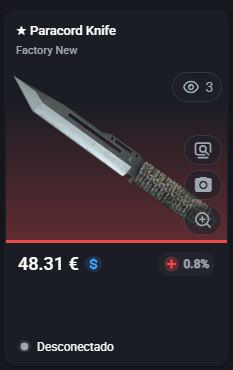
I bought a vanilla Paracord Knife and checked its price on three different sites at the same time. The result: €48.31 on CSFloat, €52.50 on Skinbaron, and €69.76 on the Steam Community Market.
Same knife. No StatTrak, no condition variance, no variables — a vanilla has no float or wear, so the skin is objectively identical across all three listings.
€21 difference between the cheapest and the most expensive. And the real gap is even bigger.
The Steam Wallet trap
What that €69.76 Steam Market price doesn't tell you is that the payment doesn't come from your bank account — it comes from your Steam Wallet. And once money's in there, you can't pull it back out. There's no "send to my bank" button. That money only exists inside Steam.
If you topped up your Wallet specifically for this purchase, you had to move that money from your card or PayPal into a balance that will never leave. On CSFloat and Skinbaron you pay directly with a card, SEPA transfer, or PayPal: the skin lands in your inventory, the money leaves your bank, end of story.
That asymmetry doesn't show up in any top-Google listicle. It's the first reason why buying skins on the Steam Market almost never makes financial sense.
How this cold comparison works
CSFloat, based in the US, charges sellers a 5% fee and charges buyers nothing extra. The listed price is what you pay.
Skinbaron, a German platform, bakes its fee into the displayed price. No surprise charges at checkout.
Steam Market charges sellers 15%, already deducted from the displayed price. But the payment method is the Wallet — and that's the invisible surcharge.
CSFloat: €48.31 in real money. 30.8% cheaper than Steam.
Skinbaron: €52.50 in real money. 24.7% cheaper than Steam.
Steam Market: €69.76 paid in trapped money.
CSFloat comes out €4.19 cheaper than Skinbaron on this particular skin. That's not a gap that should decide things on its own — prices between marketplaces fluctuate daily and the difference can flip. What is clear is that either one absolutely destroys Steam Market.
My experience buying on CSFloat
I've bought on CSFloat several times and the experience has been clean each time. The flow is what you'd expect from a serious marketplace: find the skin, pay by card or PayPal, get the Steam trade offer, accept it.
What gives the system its trustworthiness is escrow: the buyer's money is held by CSFloat for the full 7-day Steam Trade protection window. If the seller tries anything sketchy during that window, you get your money back. Support responds fast if something goes sideways.
Trade offers arrive within 5 minutes of payment, as long as the seller is available to accept the transfer on their end.
And buying on Skinbaron
Skinbaron is the strongest European alternative. It works just as well as CSFloat in my experience: card or SEPA payment, money in escrow for the 7-day protection window, support that actually responds and resolves issues.
The downside of Skinbaron versus CSFloat is that on many skins it ends up a couple of euros more expensive — like on this Paracord. But being a German company with direct European payment methods makes it the "less exotic" option for most Western players in terms of paperwork, support language, and bank dispute resolution if something goes wrong.
If one platform goes down tomorrow, the other is an instant Plan B.
The 7-day trade hold
Any freshly listed skin carries what Valve calls Steam Trade Protection. If the skin hasn't been in the seller's inventory for long, the maximum trade hold can be 7 days.
This isn't a bug with the third-party platforms. It's Valve protecting users against compromised accounts: even if someone hijacks an account and moves a skin, Valve can reverse the trade during that week. It's solid protection, but it means that when you buy a "fresh" skin your money sits in escrow for that window.
If the skin has been in the seller's inventory for a while, the hold can drop to fewer days or even be instant. CSFloat and Skinbaron usually show you this before you buy.
Is waiting 7 days a problem? For skins you're going to use, no. For investment skins where prices fluctuate, that hold means you can't flip what you just bought for a full week. Worth keeping in mind.
Other platforms worth knowing about (without having used them myself)
Three more marketplaces always come up in these comparisons. I haven't used them personally, so what follows is what's known in the space — not a firm recommendation.
Buff.market, the international version of the Chinese Buff163, has a reputation for the lowest prices in the market, especially on high-tier skins. The historical catch was that most payments went through Chinese methods (Alipay, WeChat); the international version accepts more options but the learning curve is steeper than CSFloat or Skinbaron. It's where buyers look when the skin they want costs hundreds of euros and a 10% saving adds up to a real number.
DMarket is an established platform that accepts card and crypto, with a massive inventory. Reported fees in forum discussions run slightly higher than Skinport or Skinbaron. General reputation is solid.
CS.Money is more focused on trading (skin-for-skin swaps) than straight cash purchases. It has a cash-out option but with higher fees than purchase-focused platforms. Useful if you want to offload several skins to land a specific one without going through euro liquidity.
My recommendation for the average buyer is to start with CSFloat or Skinbaron for two reasons: direct European payment methods and a minimal learning curve. If the skin you're after is expensive and you're seeing hundreds of euros in savings on Buff, that's when it's worth reading a few platform-specific guides and making the jump.
The "don't lose money" protocol for any marketplace
Doesn't matter which platform you use — third-party or Steam Market — three rules never fail.
First: never pay outside the platform's escrow. If a seller pitches you "I'll give you a better price if we do it off-platform via PayPal direct," it's a 100% scam. Escrow is the only thing protecting you.
Second: check the domain. Before entering card details, verify the URL is the real one (csfloat.com, skinbaron.de — not csfloat-shop.net or any variant). Phishing clone sites exist and sometimes show up in Google ads.
Third: have Steam Mobile Authenticator active on your account. Without it, trade offers go into a 15-day manual confirmation delay — turns the 7-day trade hold into 15+ days, and many sellers won't even accept you as a buyer.
Conclusion
If price is your priority: CSFloat. The same skin came out €21 cheaper than Steam Market in this specific comparison, and the buying experience is clean.
If CSFloat doesn't have the skin you're after or you want a closer European alternative: Skinbaron. A couple of euros more expensive on average, but equally reliable.
If Steam Market is your "easy option" because you don't want to deal with third-party marketplaces: count the real cost, not just the on-screen price. You're paying 30% more for the same thing, in money you can no longer withdraw.
Buff, DMarket, and CS.Money are second-tier options: for very expensive skins where the learning curve pays off, or for specific trades. For someone buying a mid-tier skin one-off, the first two platforms are more than enough.
Frequently Asked Questions
Why is buying CS2 skins on external marketplaces cheaper than on the Steam Market?
In this specific comparison, the same knife cost €48.31 on CSFloat versus €69.76 on Steam Market — 30.8% more expensive. On top of that, Steam Market only accepts payment via Steam Wallet, a balance you can't withdraw to your bank. CSFloat and Skinbaron accept card or PayPal directly, so the real cost is exactly what you see on screen.
What's the difference between buying skins on CSFloat versus Skinbaron?
In the Paracord Knife comparison, CSFloat came out €4.19 cheaper than Skinbaron, though prices fluctuate and the gap can flip. Skinbaron, as a German company, offers European payment methods and more accessible support for dispute resolution. Both are equally reliable; if one goes down, the other is an instant Plan B.
What is the 7-day CS2 trade hold when buying skins, and how does it affect you?
It's Valve's Steam Trade Protection: if the skin hasn't been in the seller's inventory for long, it stays in escrow for up to 7 days before you can receive it. For skins you're going to use it's not an issue, but if you're buying to flip, it means you can't resell for a full week. CSFloat and Skinbaron usually show you the hold before you pay.
When is it worth using Buff to buy CS2 skins instead of CSFloat or Skinbaron?
Buff typically has the lowest prices in the market, especially on high-tier skins, but the learning curve is steeper than CSFloat or Skinbaron. For a one-off buyer picking up mid-tier skins, the first two platforms are more than enough. Buff is worth considering when the skin is expensive enough that the price difference adds up to real hundreds of euros in savings.